The Lake

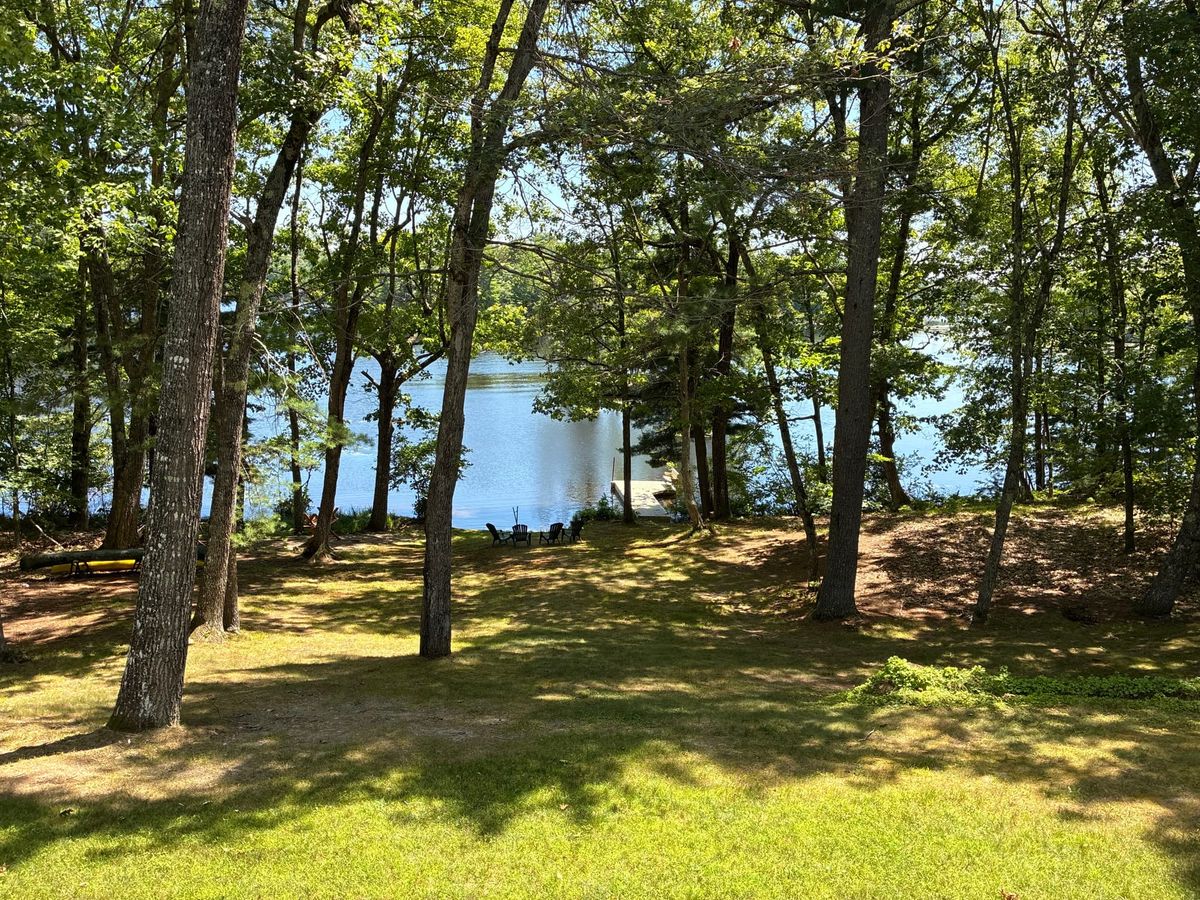
The lake in the morning is absolutely silent except for the birds, who yell at each other from the tops of the trees that crowd the shore. There is something about the way the bright green of their leaves looks against the navy blue of the water that feels like a deep inhale, the one that gets all the way to the bottom of your lungs after you’ve been holding your breath for a while.
I have a lot of history with this lake. The first time I ever came here was almost thirty years ago, when the parents of my best college friend sold their house in the suburbs of New York City and retired to Maine. They bought a house in the middle of the woods with a ridiculous driveway that slopes down almost 45 degrees from an unpaved road and a gorgeous deck off the back. The deck looks out over another sloping hill, a sun-dappled stretch of earth covered with pine needles that dead-ends right into the lake. I’ve never been here in the winter, when it gets icy and treacherous, but the lake in the summer makes you forget there are such things as ice and treachery.
My friend’s parents adored it up here, especially her mom, who fell head over heels in love with the lake, and the house, and with their little community in the middle of nowhere Maine. On one of my visits many years ago, I woke up early and looked out the window while I sipped coffee from a mug with MAINE, THE WAY LIFE SHOULD BE printed on it. I watched my friend’s mom taking an early-morning swim in her beloved lake, her head bobbing happily above the water, the only bit of movement in the morning stillness.
She passed away a month ago, in early July, from a rare and horrible cancer that was diagnosed three weeks after the death of my friend’s dad. I came out for her funeral and spent a few days with my friend at the now-empty Maine house while she performed the rites and duties of a loved one’s passing. I am now at the age where these duties, and attending the funerals of my friends’ parents, are familiar.
The night before the service, we sat in the living room with the wall of windows that overlook the lake and laughed until we cried at some old photos of us in college that her mom had in a drawer. “LOOK AT MY HAIR,” I yelped, horrified. “DID WE DO ANYTHING EXCEPT SMOKE CIGARETTES AND DRINK CHEAP BOOZE?” my friend yelped back, waving a particularly incriminating shot. “I MEAN, NOT REALLY,” I gasped, taking off my glasses to wipe my eyes.
Without my glasses the room went blurry, unfocused. I looked at my friend with my ancient, failing eyes, and her beautiful, middle-aged, English-rose face was suddenly timeless, fuzzy around the edges. The almost forty years we have known each other curled around us like one of the blankets her mom had scattered around the room for when the nights get chilly.
I arrived here yesterday, for a few days of precious alone time in the midst of a ten-day pilgrimage that I do every summer to see friends on the east coast. I look forward to this trip every year, and I’ve been particularly excited about the prospect of a few days at the Maine house, among the pine needles and the birds and the silence.
Although I was born in Chicago and now live in Minnesota, Maine is in my DNA. My dad’s mom was raised in Fort Kent, which is the farthest north you can go on Route 1 before you smack into Canada, and I have family scattered across the state from Bangor to Mechanic Falls. I went to college here, in Lewiston, and my husband asked me to marry him here, while we were staying at the family home of one of his college friends near Bar Harbor. For someone who has spent the majority of her life firmly planted in the midwest, a lot of my core memories have Maine roots.
My college friend is not here at the moment — she and her husband are currently celebrating their ten-year wedding anniversary in Italy and Croatia — but when I was up for her mom’s funeral she suggested I stay at the house during my trip. She couldn’t find the keys to the front door, but she gave me the garage code and told me that the door to the house from the garage would be open. “We don’t really lock anything,” she said with a shrug. “If you have any trouble, just ask the neighbors. Or climb in through one of the windows.”
Maine, the way life should be.
I did have a moment of panic yesterday when I arrived and the door to the house from the garage was not, in fact, open, but after a bit of jiggling I figured out that I was just turning the doorknob the wrong way. I dropped my stuff in the living room and immediately went out on the deck to look at the lake. It was busy on a Sunday afternoon: the pontoons were out, and I could hear the jet skis roaring on the other side of the island that shields this side of the lake from the busier bit where the houses are closer together and there’s a public beach.
My creaky perimenopausal bones were tired from the three-hour drive up from Connecticut, the first stop on my pilgrimage, but I changed into my sensible black two-piece middle-aged-lady swimsuit and took the kayak out anyway. I paddled out past the island towards the beach, waving at the pontoon people when they waved at me. You violate the politics of the Lake Wave at your peril.
After twenty-five years in Minnesota, I am fluent in Lake. Minnesota has a lake culture that is similar to Maine’s — one of the many ways in which the two places are alike. I had enormous deja vu the first time I visited northern Minnesota, a few years after we moved there in the early aughts, because the lakes and woods of Minnesota look, sound, and smell exactly like the lakes and woods of Maine. It was the smell, especially, that triggered my weird sense of return to a place I had never been before.[Aside: I just looked up “why do Maine and Minnesota smell the same?” and the google machine tells me it’s because both states sit along the border of the Laurentian Mixed Forest Province, where the North American ecosystem transitions between northern boreal forests and southern broadleaf forests. This gives them “a nearly identical mix of aromatic organic compounds,” which is the google machine’s fancy way of saying that if you close your eyes on a lake in the middle of Maine, it smells like you could be on a lake in the middle of Minnesota.]
I’m thinking about Maine and Minnesota and other random things as I paddle along, waving at the pontoon people and trying to steer the kayak around the wake from the jet skis. It is a perfect afternoon, sunny and warm but with just enough breeze to keep my creaky perimenopausal bones from overheating. I alternate between paddling and just floating, closing my eyes and titling my face up into the afternoon sun and smelling the Mainesotan smells.
At one point when I open my eyes, I have floated into a particularly deserted bit of lake, and I realize that I’m entirely alone, with absolutely nothing in my line of sight in any direction except the lilypads and the wind on the water and the whispering trees. It occurs to me, suddenly, that a woman out on a kayak by herself on a deserted lake in the middle of nowhere Maine is the perfect opening sequence for a true-crime documentary. It occurs to me, suddenly, in the idyllic silence of this beloved lake in this beloved place, to be afraid.
I wonder sometimes if men understand, or are even aware of, the calculus that women do every day, every hour, every minute. The scanning of the room, the crossing of the street, the moving to a different part of the subway. The checking to see when sundown is, so as not to be out for a walk after dark. The watching, the listening, the assessing, the constant vigilance. The deep-seated dread in knowing that vigilance isn’t always enough.
I am the mother of boys, and I have always tried to impress upon them the importance of watching out for the girls in their lives. When my older son was in middle school, I drove him and a girl in his friend group home from a birthday party that ended late. When we dropped her off, I instructed him to get out of the car and walk her up to her door and not leave until she was actually inside the house. When he got back into the car, I said “you know that you always do that with the girls, right?” and he rolled his middle-school eyes and said “I KNOW I KNOW MOM YOU DON’T HAVE TO REMIND ME.”
My sons are in their early twenties now, and have grown into the kind of young men who don’t need to be reminded. They take after their father in that way, among many others. But I know all too well the poisonous, insidious forces that are at work in their lives — forces that would love to replace their mother’s nagging and their father’s example with resentment and fear and hate and violence.
I will never stop reminding them.
My time at the Maine house is solitary and silent and magical. I drink coffee on the deck while I write and stare at the lake and listen to the trees and think big thinky thoughts. I put together a Mickey Mouse jigsaw puzzle I find at the nearby Dollar General. I eat when I remember to. I ignore my email and social media and give myself a break from the news, which is nothing but resentment and fear and hate and violence, these days.
A lot of my big thinky thoughts are about the passing of time, in this place that holds so many memories. I sit in the adirondack chairs down by the lake, which are placed in the exact spot where I stood as maid of honor in my college friend’s wedding — the one to her first husband, not the one with whom she’s currently frolicking in Italy. Almost thirty years ago now, I stood there in a hot pink taffeta skirt and a cream-colored silk sweater set (those two-piece outfits were all the rage for bridesmaids in the late twentieth century) and watched my beautiful, hopeful friend make promises to a man who a few short years later would turn out to be broken in ways that were unfixable.
Hers is not my story to tell, but it’s only notable in how commonplace it is. Women and men and hope and brokenness.
I call my husband back in Minnesota to check in on him and Macy, our elderly dog. The mystery ailment that has plagued Macy for the last year has gotten much worse in recent weeks, and I have horrible guilt about being gone while my husband deals with her decline on his own. My husband and I are unusually terse with each other while we discuss her various symptoms and medications — me because I feel terrible that I’m not there to help and him because he feels terrible that I feel terrible. Later that day, he texts me to apologize for being a downer on the phone. “I think I’m just very bummed out about Macy,” he says, and it occurs to me how many men cannot even begin to articulate that kind of sadness, or anything else that might hint at a soft and tender heart, and how the world burns because of it.
I think about him and the boys we’ve raised together, boys who are turning into men before our very eyes, and I feel lucky and melancholy and terrified and hopeful all at the same time.
On my last morning at the Maine house, I take the kayak out early. The lake is absolutely still; it’s before 9 a.m. on a weekday, and no one else is out yet except a dude in a bucket hat on a flat-bottomed boat that he’s pedaling like a recumbent bike, with a couple of fishing rods sticking up off the back. He waves to me, and I wave back.
I paddle out past the island and decide on a whim to steer the kayak to the left, to a part of the lake I haven’t seen before. I am, once again, totally alone — bucket hat guy has disappeared around a bend — but this time I don’t feel afraid. I notice a little beach tucked away in the trees, and I pull in to sit on the sand in the sun for a bit. I can’t decide if the peace I feel is real, or just the magic of a few days of solitude in a house on a lake in Maine. I decide to believe it’s both.
I’m on a schedule today, so I have to haul myself up before I’m really ready to go. As I paddle away from the little beach, I squint at the trees in the distance so I don’t miss the turn that will take me back to the house. This isn’t as easy as it used to be, because my eyes are terrible and also because you can’t always trust your own sense of direction on the water. Sometimes when you try to see way out ahead in the distance, your eyes can fool you into thinking that you’re at a standstill. It’s a terrible feeling, that moment of paralyzed panic. But then you take a breath and focus on what is right in front of you, maybe jiggle the doorknob a bit, and you realize that you really are moving forward in the right direction.