Only Connect

On writing, social media, and living in fragments no longer.
I have a friend who is a writer. Like, an actual writer, one who has written books that publishers have published and national newspapers have reviewed and people have purchased with real American dollars. Probably other currencies too.
I met this friend on pre-Musk Twitter, and our origin story is basically words and how much we both love them. As long as I have known her, she has nagged me to write things other than snarky posts on social media, and I have always resisted her efforts because I am at heart a recalcitrant toddler and also because writing things other than snarky posts on social media would be terrifying and hard.
She was at it again the last time we had brunch. “I can’t just stop everything and, you know, be a writer,” I said petulantly, stabbing at the organic eggs on my plate.
“No one can,” she said, taking a delicate slurp of her gazpacho. “Do it anyway.”
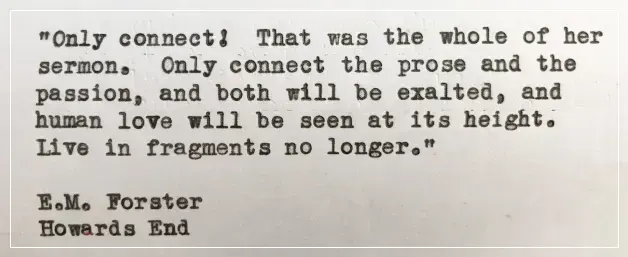
There has always been a lot of debate in Literary Circles about what British author E.M. Forster meant by “Only Connect,” which is the epigram to Howards End. Described by the famously self-deprecating Forster as “approaching a good novel,” Howards End is a madcap romp through the class tensions of Edwardian England, but it is really about how comically, tragically bad most people are at forging authentic connections with each other. In the novel, the main proponent of “only connect” is the annoyingly idealistic but lovable Margaret Schlegel, who is a bit of a drama queen but who is also very earnest in her determination to make meaningful human connections:
“Only connect! That was her whole sermon. Only connect the prose and the passion, and both will be exalted, and human love will be seen at its height. Live in fragments no longer.” —Howards End, chapter 22
In the century-plus since Howards End was published in 1910, readers and literary critics have spent more time dissecting "only connect" than is probably healthy for two little words. It’s Forster’s celebration of the persistence and insistence of love, or his despair at the insurmountable barriers of class and gender, or his directive to connect one’s head with one’s heart, or a commentary on the impossibility of connecting our conventional personalities with our transgressive desires, or or or—
Whatever. The interpretation of “only connect” that resonates the most with me at this particular moment in time—a moment defined by the rise of fascism and the lingering effects of a global pandemic and the general feeling that the world is burning both literally and figuratively—has to do with technology.
This is ironic, because Forster himself was something of a technophobe. He feared that the technology of his time (airplanes, automobiles, the telephone) would fuck up true human connection even more than humans usually manage to fuck it up on their own. “Science . . . is enslaving [man] to machines,” he wrote in his journal in 1908, and if the extent to which our eyeballs are now superglued to our devices and our brains are being rotted by Ai slop and our "facts" are now "alternative" is any indication, he was 100% right.
But he was also 100% wrong, and this brings me back to my writer friend, she of the books and the gazpacho and the gentle nagging. On paper, there is absolutely no reason why she and I should ever have become friends. None of the pre-existing conditions that are the foundation of most friendships are true for us: no friends or family or profession in common; no shared geography or workplace or alma mater. We are probably fewer degrees of separation from Kevin Bacon than we are from each other, except for the fact that we once stumbled over each other's words on a social media platform, grabbed onto each other to keep from faceplanting, and have never let go.
I spend a lot of time on social media--mostly on Threads, which is where I ultimately landed post-Twitter--and so am very aware of the paradox of these platforms. Social media amplifies our worst impulses, is a scourge on humanity, and should probably be wiped off the face of the earth; it is also a tool for incredibly powerful and authentic human connection, both individually and collectively.
I feel this paradox intensely, because these platforms make me absolutely insane and are also the source of some of my most rewarding connections. They are also where I have always done most of my writing, such as it is. In fact, I did not realize how important that space and those connections were to me until the 2022 meltdown of Twitter, burned to the ground by Elon Fucking Musk like one of his doomed SpaceX rockets. The intensity of my grief and rage at the loss of pre-Musk Twitter took me by surprise until I realized what I was really grieving: words, and the way the world vibrates when you send them out into it.
One of the things I appreciate most about my writer friend is that she has never once said to me “you should write because you are a good writer” or “you should write because other people will like your writing” because she’s not a liar and both of those things would be lies. I mean, they might be true occasionally, but the lie is in the should, that a person should write for any other reason than “if I don’t write this down somewhere, my head will explode.”
And so, here we are. I figured out that I needed more than snarky posts on social media for all the words, and to keep my head from exploding. Only connect the prose and the passion, and...live in fragments no longer.