Homage

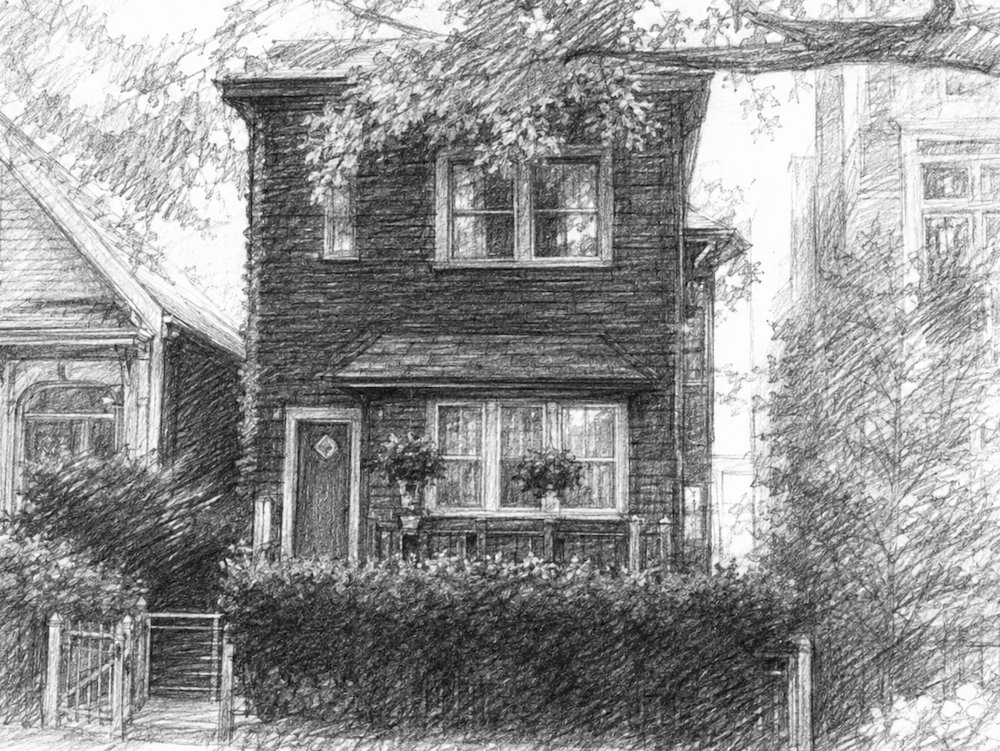
What I learned from the creaky, beautiful disaster that was my childhood home
When my parents bought the house that became my childhood home in the early 1970s, it was an absolute disaster of a place and everyone thought they were crazy.
The house was a typical Chicago two-flat, skinny and flat-roofed, built in 1873 during the frenzy of construction known as the Great Rebuilding after Mrs. O’Leary’s cow kicked the lantern over and burned half the city down in 1871. Originally, it was probably built as a duplex, but during the Depression it had been converted into a boardinghouse with six tiny apartments spread across two floors and a basement.
When my parents bought it, it hadn’t been lived in for years. The inside was filthy and smelly and dark, with a huge splintery hole in the floorboards on the second story in what would become my parents’ closet. The outside wasn’t much better, with a creaking, death-defying wooden staircase leading up to the creaking, death-defying wooden front porch. The original wood siding was covered in ugly brown tar paper, with a rectangular pattern that was supposed to look like bricks.
My parents hired an architect who gutted the place down to the studs and then built it back up, a single-family phoenix rising from the ashes. The only original interior wall left standing was just inside the front door, separating the entryway from the tiny family room, which we called the “den”—appropriate because that was where we spent most of our time as a pack. The den was where we watched TV and my dad read the paper and my mom did crossword puzzles and where we ate dinner at a round table shoved up against the front windows. When my brother and I left for college, the dinner table was replaced by a couch so that my mother’s yipdog could lie along the back and stare out the windows, keeping an eye on the neighbors during the day and the drunks who peed on our lawn at night after the bars on Lincoln Avenue closed.
The den led into a galley kitchen with a bright yellow linoleum floor and a trash compactor that stopped compacting sometime around 1978. On the far side of the kitchen was the "formal" living and dining room, rarely used except for Thanksgiving and Passover and my extremely short-lived piano lessons. The rest of the first floor was a long hallway with a hardwood floor that the architect told my parents they should refinish every five years. In the forty-five years they lived in the house, they refinished it zero times.
The hallway with its battered floor was the papyrus upon which the hieroglyphics of my childhood were inscribed: games of Mousetrap and Clue and Hungry Hungry Hippos; my gymnastics and ballet practice; my brother’s Hot Wheels racetracks and Star Wars action figures. He and I used to roller skate around and around the first floor in the circle created by the hallway and kitchen, with sharp U-turns through the living room and den.
Although the entire inside was renovated from top to bottom before they moved in, my parents never did a single thing to update the outside of the house. The tar paper that was nailed to the exterior remained, weathering the years and the Chicago winters with Depression-era fortitude. “Who cares what a house looks like on the outside?” my dad always said with a shrug.
[Actually, it’s a lie that they never did anything to the outside. At some point in the early 2000s, the ceiling of the living room started to leak, and it was determined that a section of the tar paper on the back of the house had finally given up the ghost and was letting rain in through the century-old wood underneath. I almost had a heart attack when my mother told me they were actually tearing off the tar paper and putting up siding. What I didn’t realize until the next time I visited is that they only put the siding on the back of the house, where the leak was. The tar paper on the front and sides of the house remained intact, stoically victorious over leaks and unnecessary curb appeal.]
Because it was the 1970s, my childhood bedroom had bright green shag carpeting the color of Astroturf; my brother’s carpet was blood red and made his room look like a permanent homicide scene. His room was slightly bigger than mine but had almost no natural light; the only window was a tiny porthole that looked directly into the six-flat next door. My room was at the back of the house, with three huge windows overlooking the gorgeous, ancient maple tree in our tiny backyard.
I loved my bedroom. I have always preferred being by myself, and my childhood room had everything I needed: my books, my Barbies, my ballet posters, my collection of Seventeen and Young Miss magazines, my bed with its white and blue Merimekko comforter. Very little about my room changed over the years: the Barbies eventually got tossed, and the Little House on the Prairie and Nancy Drew books were eventually replaced by Sweet Valley High and V.C. Andrews and then by Jane Austen and Margaret Atwood, but the fundamentals, including the green shag carpet, remained the same. There was no reason to change it, no reason at all.
I realize now, as an adult, that this is how my parents felt about the entire house.
I remember them painting the walls exactly once. The non-compacting trash compactor was never replaced; it just became a regular trash can in a drawer. The bright yellow linoleum kitchen floor was also never replaced, and it was decidedly less bright by the time my own kids were crawling on it. They played with my brother's old Hot Wheels and Star Wars action figures on that same battered, never-refinished hallway floor that he and I had destroyed with our roller skates. There was no reason to change it, no reason at all.
My parents’ decision to sell the house happened in the same way that Mike in The Sun Also Rises goes bankrupt: gradually, then all at once. By 2016, they had hemmed and hawed about it for years. I had lived in Minnesota since 2001 with my husband and, eventually, two kids; my brother, whose work is film-industry-adjacent, had settled in Los Angeles.
The Chicago house was starting to feel like a burden. It was way too big for just the two of them, and the leaky living room ceiling was just the beginning; the tar paper wasn’t the only thing in the house giving up the ghost. My parents started spending a few weeks in Los Angeles every winter to escape the awfulness that is Chicago in January; when my brother and his wife had kids, a few weeks quickly turned into a few months. The developers who had been after them to sell for years smelled blood, and my dad stopped hanging up on them.
The end finally came in December 2016. We were in L.A. for the week between Christmas and New Year’s, and my husband and I had taken the kids to Santa Monica for the day. We had plans to meet my parents for dinner on Third Street, so we made our way up the ramp from the pier to find my dad waiting for us on the corner of Ocean Avenue with big news.
“We just sold the house!” he announced with a huge grin. “Wait, you did WHAT?” I said, trying to keep the kids from getting trampled by the throngs of people coming off the pier.
“We SOLD the HOUSE,” he repeated, as if he couldn’t believe it either. “Well, congratulations and THANK GOD,” I said, laughing and hugging him and trying not to cry.
They sold it for an insane amount of money to one of the blood-sniffing developers, who promptly tore it down and sold the land for an even more insane amount of money to the next-door neighbors, who wanted a side yard and also to not lose the gorgeous, ancient maple tree, which provided their back porch with a lot of very nice shade in the summertime.
I learned a lot from growing up in that house. I learned that a thing can be creaky and ugly and worn on the outside, and filled with laughter and love and whimsy on the inside. That you don't have to do things just because someone tells you that you should, or because that's how other people do it. That you hold on to the things that are important, and then, when the time is right, you let them go.
About five years ago I had a dream about the house. In my dream, I was in my room and everything looked exactly like it did when I was growing up: the bed with the white and blue Marimekko comforter, the green shag carpet, the bookshelves and ballet posters covering the walls.
There were bins of dusty rags on the bed, as if someone had been in the room cleaning, and I dream-thought “wait a second, who's been in the house?” since I knew my parents had moved out years ago. And then I remembered that the house had been torn down. "This house doesn't exist anymore,” I said to myself as put my hand on the bed, which felt just like I knew it would. I realized that I needed to touch everything before it disappeared, so I walked around my childhood room and touched things: the comforter on the bed, the horrible green shag carpet on the floor, the dresser, the walls, the books on the bookshelf. I put my hand on my childhood bed one more time and said “I love you,” and then walked out of the room and shut the door behind me. And then I woke up.